


A few months ago, I had a conversation with Mark Teh from Five Arts Centre about research and NotebookLM. What struck me was the discussion of how research can enrich the creative arts by offering different perspectives—a theme he explored in several of his directorial works, including Fragments of Tuah.
At the same time, I noticed growing interest in conducting research to provide context in the creative arts. There is a common misconception that creative arts1I use the term creative arts to encompass the broad range of arts, including visual arts, performing arts, literary arts, and media arts. are only for expressing oneself, and that people in the arts have too many feelings, which leads to a lack of grounding. One of the common statements that I always hear is “Art can analyse meh? Not feels only ah? (I didn’t know analysing art is a thing, and it’s not based purely on emotions?)”
I acknowledge the broad spectrum of the arts — from pure entertainment to emotional expression. However, I believe that incorporating research is essential because it bridges gaps across different backgrounds, revealing deeper meanings that the audience might miss on their own.
Hence, I decided to watch Fragments of Tuah during the KL Festival in May 2026 to understand how the team integrated the research into their theatre documentary. Would it be too dry with too many facts, especially when the word ‘research’ was mentioned months earlier? Would it be like a standard documentary, with the narrator often in third person and some interviews to highlight the layperson’s voice? I decided to find out these answers through this performance.
Who is Hang Tuah?
Hang Tuah, a warrior of the 15th-century Malaccan sultanate, represents the ideal Malay subject and remains an icon of Malay nationalism to this day. Being a product of national school, I am familiar with Hang Tuah’s heroic deeds and loyalty towards the Sultan through textbooks. Some of the materials that often highlight Hang Tuah are Hikayat Hang Tuah (The Epic of Hang Tuah) and the Malay Annals (Sejarah Melayu). However, there has also been much speculation about who Hang Tuah really was, both in the past and in modern times. Just mention the topic of Hang Tuah casually to some Malaysians, and you will get a variety of conspiracy theories, either in conversations or on social media.
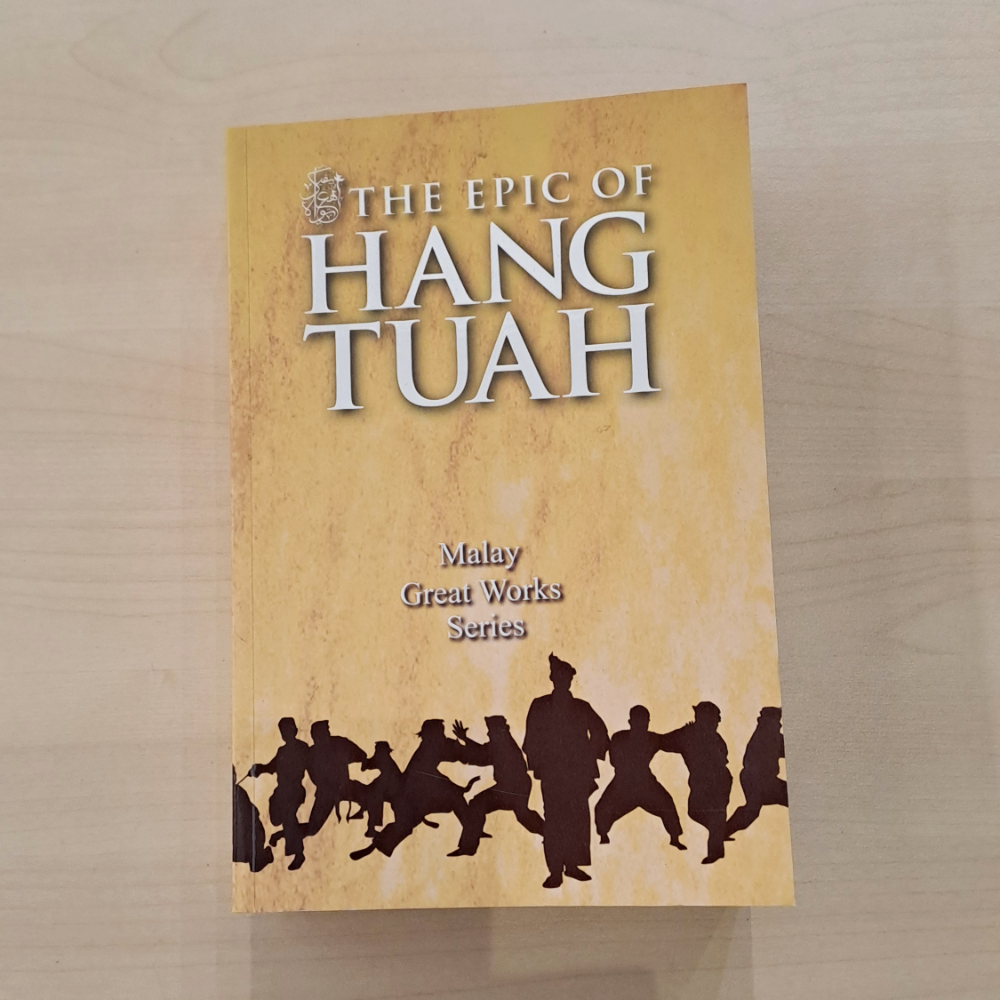
After watching Fragments of Tuah, I found The Epic of Hang Tuah in Abe’s Archive in Ipoh.
Research
Since I was curious about the research aspect of this performance, I will highlight the research aspect first. To understand who Hang Tuah is in the context of Malaysian history and why he is revered today, research is needed to examine what authors and creators have said about him. In Fragments of Tuah, I was in awe of the depth and breadth of research that spanned different forms — from written materials to films, aerial and street-view maps, TikTok videos, and fragments of the Hikayat Hang Tuah across Leiden University, the British Library, the Royal Asiatic Society, and SOAS.2https://www.eksentrika.com/fragments-of-tuah-hang-tuah-five-arts-centre/
Most of the research comes from written materials, as evidenced by the books on stage and the backdrop made of paper, which represent the stories explored. The performance began with the sound of waves as three paper backdrops slowly rose, which reminded me of how one would open a book and begin a journey to piece together these fragments.
As part of the research on Hang Tuah, one of the striking images was the Hang Tuah bronze mural found at the Muzium Negara, also known as the National Museum. As they showed the sculpture, snippets of the artist sharing her process for creating Hang Tuah were shown. The process of the bronze mural in the museum was institutionalised, suggesting a direction of putting forth a foundation of Malaysia’s nation-building narrative.
The Fragments of Tuah did not only focus on written materials. P. Ramlee’s film Hang Tuah was shown, a 1956 film, and the scene shown was a story of Hang Tuah and Hang Jebat. That fight scene is one of the most talked about in conversations. Both Hang Tuah and Jebat fought until Hang Tuah murdered Hang Jebat. This scene highlights the conflict between the two warriors that led to the fight. Hang Tuah was loyal to the Sultan, while Hang Jebat was known for his rebellion against the ruler. The fight scene dragged on as Faiq narrated, and I was trying to understand the selection of the scene in the context of this performance. It was only later that I learnt that Hang Tuah and Hang Jebat fought for seven days. Perhaps this scene was highlighted to underscore the importance of loyalty to the Sultan within the nation’s narrative. Furthermore, P. Ramlee is known for his nationalist tropes in his films, and this film was among many that highlighted them.
In other forms of documenting the continuity of the 15th-century warrior, Faiq shared about the Hang Tuah expo in Malacca. He described the exhibition, including the demographics of the attendees. To me, that felt like a video and oral history of his journey there, adding to the depth of the Hang Tuah experience years later. One of the contested artefacts was the Hang Tuah keris that was found in Okinawa. In Hang Tuah: Catatan Okinawa, the keris excavated in Japan is believed to belong to Hang Tuah.3https://www.fiveartscentre.org/process/time-is-a-material The team visited the Okinawa Prefecture Archaeological Centre to check on the alleged keris, and the reports contradict the claim that Hang Tuah’s keris is in Japan. With that conflicting information from Hang Tuah: Catatan Okinawa and the report presented to the audience, the audience was challenged to think about what is real and what is a myth.
The ongoing nature of research also reveals that Hang Tuah did not only remain a historical figure of the past, as there have been TikTok posts about Hang Tuah in modern times. In every era, there appeared to be a continuity of Hang Tuah but in evolving forms. Each TikTok video was compiled, and it was obvious some were AI-generated. It is easy to dismiss some of the videos as not credible because of how platforms are categorised and institutionalised. However, these social media videos are also data reflective of different times, and of how a Malay warrior in the 15th century continues to this day.
In academia, we are often reminded that everyone has biases, and that we do not fall into them during our research. Sometimes, in researching certain topics, we are bound to find materials that do not align with our worldview. The most important thing is to present your research and let others decide what to do with the information. Disagreement of thoughts is normal, and not every disagreement is an attack on our beliefs. We need to take the information, process it, and determine our stance.
Storytelling and reflections
Fragments of Tuah utilised the role of the narrator throughout and employed different forms of storytelling. The role of the narrator was played by Faiq Syazwan Kuhiri. It began with the role of Penglipur lara. A penglipur lara is a storyteller in Malay oral history, especially in the past when illiteracy was high. In the past, penglipur lara’s storytelling was accompanied by music. In the current context, Fragments of Tuah utilised multimedia elements to tell a story, including text, videos, audio, and visuals, engaging all our senses while provoking thought. One phrase I particularly remember to this day was ‘Nation and Narration’. The catchy, alliterative statement gave direction on what it would focus on, which was Hang Tuah in the nationalist narrative.
Fragments of Tuah did not adhere to a single type of storytelling. One moment, Faiq was on stage, sharing his life stories and presenting on the history of Hang Tuah. The next thing I knew, Faiq was at the bottom of the stage, becoming the benshi. Benshi is a narrator who provides live commentary on silent films in Japan. From the bottom of the stage, he narrated the story of Hang Tuah. At the same time, the audience was shown aerial and street-view maps of places named after Hang Tuah in the background. One familiar location popped up — the Fragments of Tuah was performed in Sekolah Seni Malaysia, which was only a 20-minute walk from the Hang Tuah interchange station. That felt almost serendipitous.
After that, Faiq was back on stage, this time holding a camera and pointing it at the audience. Our blurry video was projected onto the paper backdrops. The next thing he did was to turn the camera towards him, appearing to capture a selfie video. I felt we were back in the present day, as the scene of pointing the camera at the audience and himself is familiar in the age of reels on social media. Due to the lighting design, it was easier to focus on Faiq’s narration as a video projection on the backdrop than to watch him perform on stage. In this chapter, he discussed how the internet has evolved from the 2010s to today. The internet used to be an open space for expressing personal views and learning about the world. However, now the internet is a space where so much negativity looms alongside the abuse of generative AI.
The evolution also shows that storytelling has moved into another dimension, especially on social media, as he highlighted the influx of Hang Tuah videos on TikTok during the pandemic. The videos were too fast, but I managed to see some AI-generated videos about Hang Tuah that I couldn’t make sense of, especially the ones that portray him and his comrades as robots. The other event that happened during the pandemic was Faiq’s band Terrer’s debut of a single titled ‘Hang Loklaq’. Hang Loklaq was a music video criticising the country’s religious hypocrisy. It almost felt like a Hang Tuah and Hang Jebat fight all over again, but this time the struggle is more internalised, a conflict between the institutions put in place and one’s ambivalence.
The performance ended on a sombre note when Faiq spoke about Hang Tuah’s final days, a subject rarely spoken about. The two paper backdrops that had been raised at the beginning of the performance were lowered, covering the carefully placed books, which resembled a burial ground. As it began with the sounds of waves, it ended with the Jawi script on waves, suggesting that the stories of Hang Tuah still circulate, just as the ocean waves do. It reminds me a bit of throwing a message in a bottle, and of how Hang Tuah is not a local story but one found elsewhere, either in physical locations or online.
Overall, I felt a slight disconnect as the Faiq switched between narrative modes from penglipur lara to benshi, political spin doctor, confessional singer-songwriter, and a content creator.4https://www.fiveartscentre.org/process/time-is-a-material The story was not entirely linear, as it jumps between presenting findings and Faiq’s experience. However, as the performance progressed, I realised it was necessary to include reflection alongside research to bridge the gap between research and bringing these stories to the ground. Also, Faiq’s experiences made the performance more authentic and because he was sharing his experiences and presenting a narrative we are aware about in different manner.
Conclusion
Let’s go back to the questions that I had earlier before the show started.
- Would it be too dry with too many facts, especially when the word ‘research’ was mentioned months earlier?
- Would it be like a standard documentary, with the narrator often in third person and some interviews to highlight the layperson’s voice?
Question 1
I found the project well researched. This was collective research rather than individual research, and it involved different people researching it because I observed how the performance used many lenses (literally through the switching of storytelling types). While it could have been as dry as an academic research paper, I found myself more engaged as I absorbed the facts and following the flow of Faiq’s narration.
Question 2
This was my first time watching documentary theatre, where everything happens on stage. One of the house rules was the recordings of the performance were not allowed. With this rule enforced, I was able to experience the layers up close that videos cannot capture. It was definitely not the standard documentary style because Fragments of Tuah interspersed research and personal reflections instead of utilising the standard format of narration and interviews.
If one thing Fragments of Tuah taught me was that it is alright to combine both research and reflection. That resonates with me so much because I am reflective in nature and I journalled a lot, but at the same time, I was also trained in research. Most of the time, research is oversimplified (“Oh, I already asked Google/ChatGPT”) or demonised (“Aiya, researchers all up on the ivory tower. Where got turun padang?”). Many times, I did not know how to reconcile these parts of myself, but after watching this, it is time to embrace them.
In conclusion, with information overload and too much generative AI content, there is a need for context for the world around the things we consume. In this regard, research can help investigate some of the context. We still need experts to synthesise their findings in ways the public can understand, especially through creative arts. Fragments of Tuah is an example that presents the findings in a relatable manner and yet provokes thought and serves as a starting point for understanding the nuances and layers of what we have learnt or believe.
p.s 1: I watched this documentary theatre when I was in a sleepy state. I was rushing to meet a deadline at 12pm, just three hours before the show started. I missed some details, so I will include links in my references below if you’d like to know more from other point of view.
p.s 2: Fragments of Tuah ignited in me was my previous research about Ali Baba and the Forty Thieves in Malaysia. There were so many parts of the performance that reminded me of my research and I am going to relook at my paper and make it accessible.
References
Ista Kyra. “‘Fragments Of Tuah’: New Documentary Theatre Makes Us See The Legend With New Eyes.” Eksentrika, 2025. https://www.eksentrika.com/fragments-of-tuah-hang-tuah-five-arts-centre/.
Carmen Nge. “Stories Without End: ‘Fragments of Tuah’ by Five Arts Centre.” Critics Republic, October 17, 2025. https://www.criticsrepublic.com/2025/10/17/stories-without-end-fragments-of-tuah-by-five-arts-centre/.
Mark Teh. “Mark Teh – Time Is A Material: Some Reflections on Researching.” Five Arts Centre, May 19, 2026. https://www.fiveartscentre.org/process/time-is-a-material.
Featured image by 烧不酥在上海 老的 on Unsplash. For illustration purposes only.
References
- 1I use the term creative arts to encompass the broad range of arts, including visual arts, performing arts, literary arts, and media arts. ↩︎
- 2https://www.eksentrika.com/fragments-of-tuah-hang-tuah-five-arts-centre/ ↩︎
- 3https://www.fiveartscentre.org/process/time-is-a-material ↩︎
- 4https://www.fiveartscentre.org/process/time-is-a-material ↩︎
