


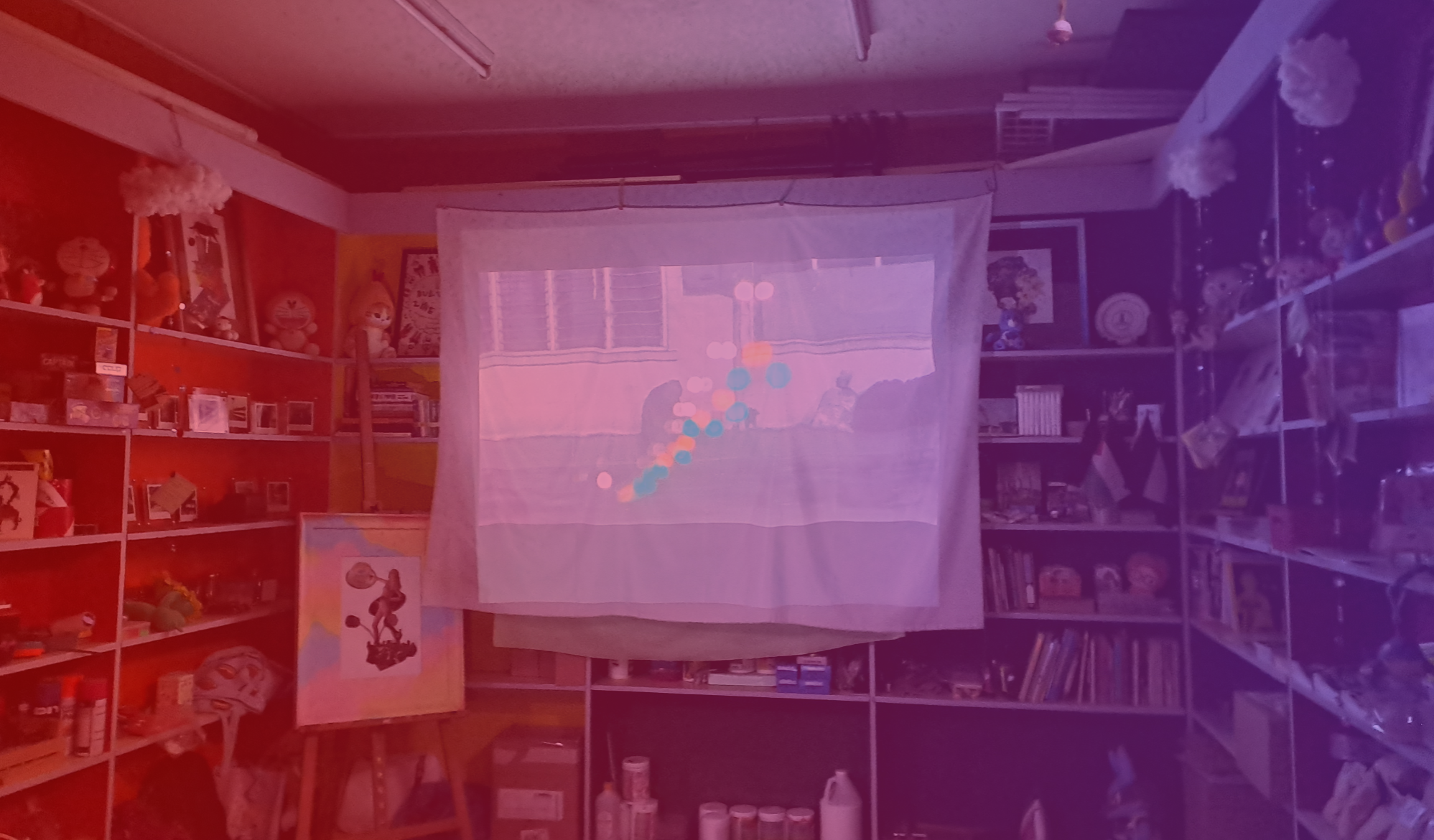
In October 2025, I attended a film screening titled Siang Dicita, Malam Mendatang. The film screening was organised by Kinta Zine Club and Kadiak at Pasar Besar Ipoh (Ipoh Central Market) and showcased a variety of films that highlight the raw and forgotten aspects of Ipoh.
As I made my way through the dimly lit corridors towards Kinta Zine Club in the afternoon, I was overwhelmed by the smells of the pasar (which I will use throughout this article). There was a lingering mustiness in the air as the pasar workers cleaned up after a busy day. The Urban Transformation Centre (UTC) was also in the market, which was a one-stop centre for government agencies for people to settle government related matters.
Walking through the pasar served as a prelude to the films I was going to watch. I was not sure what to expect, but later I found out that the sensory experiences complemented the independent films being shown. I wondered how to capture my emotions and senses about this film screening, and I came across the term psychogeography. Psychogeography is “effect of a geographical location on the emotions and behaviour of individuals.” Watching these films in the pasar created a unique atmosphere, blending the practical side of the market with the emotional impact it has on both filmmakers and viewers.
I seek to reconcile the sensory experiences of the market and my emotions from the films. Since this film screening was months ago, I have been reflecting on the films that stood out to me.
It started out with My Ipoh Little Secret, and the film opened with an interview. One of the interviewees moved from the Klang Valley to Ipoh, and said she initially did not like Ipoh. Towards the end of the film, she said she like this place. That confession resonates with me because I was struggling in Ipoh. Despite the initial revelation of the interviewee disliking Ipoh, it was interesting to hear different stories about Ipoh from different people, which were mostly unfiltered and unhinged.
The momentum continued steadily with films such as Loken, Pendosa and Ipoh City Sinners. I could not remember much after watching Loken, as it was only 1 minute of footage. In this film, Loken refers to the second-hand market in Ipoh, which is also known as Pasar Karat among locals. Despite not remembering much about the film, it evoked memories of 2017, when an artist I interviewed recommended that I visit that pasar when I had a chance.
Pendosa almost felt like a continuation of My Ipoh Little Secret, as the some of the interviewees appear in both documentaries. The same interviewees could be a matter of Ipoh still retaining its small-town dynamics, where everyone knows each other. Pendosa highlights Ipoh creatives who navigate their environment and community while still finding ways to express themselves. The interviewees spoke about what it means to be part of Ipoh, and also highlighted the charms of Ipoh’s creative arts. As a result, this creative tension produced a unique subculture in Ipoh, where people challenge norms while retaining a sense of community.
The next film was Ipoh City Sinners, which compiled rejected footage from Pendosa. The common theme among My Little Ipoh Secret, Loken, Pendosa, and Ipoh City Sinners is their focus on Ipoh town areas, with extensive footage from Pasar Besar. This footage reveals that people congregate at these infrastructures and also leads to storytelling about these places.
Moving on from the theme of local places, the next film, The Politburo dari Radio Malaya, tells the story of a band called Elisabelle Tears, active in the early 2000s. Elisabelle Tears was an independent band from Ipoh. This documentary documents the band’s journey, including their exploration of post-rock and emo, as well as the process of making their music. The former band members also spoke about their tours to Kuala Lumpur and Singapore, which were their highs. However, all good things come to an end, as they disbanded in 2004. While it is quite normal for an independent band to disband after a few years, it was sobering to learn that the drummer passed away in 2020, as highlighted in the post-credits.
After feeling the rawness of the earlier films, the tone shifted to a more informative style. The Forgotten Railways of Kinta Valley revealed a railway built in the British colonial era to support the tin mining industry. The Federated Malay States Railway (FMSR) Ipoh-Tronoh line was built in 1908, but was dismantled in 1948. I have asked a few Ipoh people about this railway in the past and many Ipoh people are not aware of this railway tracks unless they read archives or have the older generation to remember these painful memories.
Ansell Tan, the filmmaker was around for the screening, and we had a Q&A session about the film. At the same time, we discussed how to improve public transport in Ipoh so it does not repeat the mistakes made in Kuala Lumpur. While the discussion is good, it ultimately goes back to the state government’s vision for the state.
We continued with another film by Ansell Tan, titled Where did the Old Boys go? This film was made to reach out to alumni (referred to as the Old Boys) from the Anderson School in Ipoh. The Anderson School was founded in 1909 during the British colonial era. Compared to its glorious past, the school’s structure had deteriorated and needed repairs. Hence, this video was a call to reconnect the Old Boys and to raise funds to repair the school. Based on my observations, alumni from former English schools (which is now a national school) show greater school pride, which is something I do not understand as I did not grow up in such schools.
Finally, we ended with Hujan di Tengah Hari by Faris Nabil. Nabil’s film was one of the winners at the Raintown Film Festival in Taiping. Taiping is known as Raintown, as it is the wettest place in Perak. Taiping is located in the north and is about a 45-minute drive from Ipoh. Given that the area is one of the wettest in Perak, it is no surprise that the film’s theme centres on rain.
Hujan di Tengah Hari was one of the most poetic films I’ve seen. The film was inspired by the lyrics of Tun Sri P. Ramlee’s song. While I can understand the film without subtitles, I was amazed by the English translation, which was equally as poetic. To translate songs to that level, one needs to understand the nuances of different languages without losing their meaning. I also love that the film had no dialogue, which reminds me of Wall-E. There is something about films without dialogue that forces me to focus on the visuals and music of the film. I found it a good film to end the screening, as I needed to slow my brain down after watching 10 films in total, while still absorbing the pasar vibes.
Conclusion
I have to say the film curation was excellent. It highlights different aspects of Ipoh, from the raw to the former colonial to the quiet, poetic version. As a non-Ipoh person, I experience Ipoh very differently from an Ipoh native. I am unable to reminisce at the same level as Ipoh people. Therefore, the curation gave a roundedness, balancing the raw emotions and also the historical aspect of Ipoh. I learnt more about Ipoh asides from food, as many Ipoh people love to promote food more than other topics. I wish these films were used for tourism videos, rather than the standard government or corporate-style videos that are so polished to the point that it feel inauthentic.
I believe the film’s curation and narrative are more important than the location itself. In my past experience, most screenings are held in black-box theatres, classrooms, or other venues that require projection, which are urban in nature. I was proven wrong at this film screening. In the case of Siang Dicita, Malam Mendatang, the film screening at a pasar adds a layer of sensory experience that complements the films, which is something that I cannot get in the city. Finally, I understand how psychogeography can work in the context of the films and their venues because it reveals one’s behaviour and emotions toward a place. Different people will have different opinions and emotions about Ipoh, and for me, I leave with a sense of ambivalence about this place.
