


In April 2026, I attended a workshop titled Human Algorithm: Collage as Embodied Counter-Knowledge by Dewi Nurlaela (Lala) from nanyadiri at the 2nd International Conference on Film & Society in Kuala Lumpur. This is not my first time attending a collaborative art workshop, and the results vary based on the theme and the participants, as each participant brings in their own stories.
While attending collaborative art workshops is not new to me, I found this workshop challenging as I was trying to tie the correlation between human knowledge gathering and LLMs’ knowledge gathering through trained data. Given my limited knowledge of LLMs, I focused on the collage-making process among the community.
Method
I was curious about how Lala would approach the LLMs (Large Language Models) with the collage activity. We were split into two groups based on our preference for dogs, cats, or birds. Instead of being grouped with people who like the same animals, we were grouped with people who like different animals to increase diversity of thought. We were given an open-ended prompt and collectively expressed ourselves through collages and words.
As this is Lala’s research and she obtained consent for the artworks to be included, I will only include snippets of the artworks so she can analyse the full images in her research.
Re-examining this process as community building
Overcoming the fear of the blank paper
One thing I consistently observe in art-making workshops or among art practitioners is participants’ fear of the blank page, especially when the prompt is too open-ended. In the past, I have seen participants fear making a mark on the paper, thinking they might be wrong. I have also heard some saying things like, “I am no good at art”, before executing the artwork. Most of the time, this stems from the misconception that art is for the elite and should look like fine art, framed and displayed in galleries.
Therefore, encouraging people to leave a mark on paper is a gentle process, and sometimes we need the community to encourage one another. During the session, I noticed hesitation on my group members’ faces. Instinctively, I stepped in and encouraged them not to fear the open-ended nature of the prompt and the blank page.
Firstly, we opened up our envelopes to see the curated set of pictures. I was looking at it, and I went, “These pictures so cantiklah (beautiful), can we just keep them and not cut them?”
This casual statement actually got the group members talking, as they were admiring the pictures as well. What a way to break the ice without being too awkward, especially for those we met for the first time.
Secondly, my experience shows that people who are not too familiar with the creative arts need more guidance with open-ended prompts. I explained that we could cut anything from the papers and also told them that it is not limited to paper; they can use coloured pencils to write or draw.
Finally, I was thankful to have a more proactive group member who placed a character in the middle of the blank page to begin the artwork. This member’s proactiveness encouraged me to put down a piece, and I wrote my thoughts to go with it.
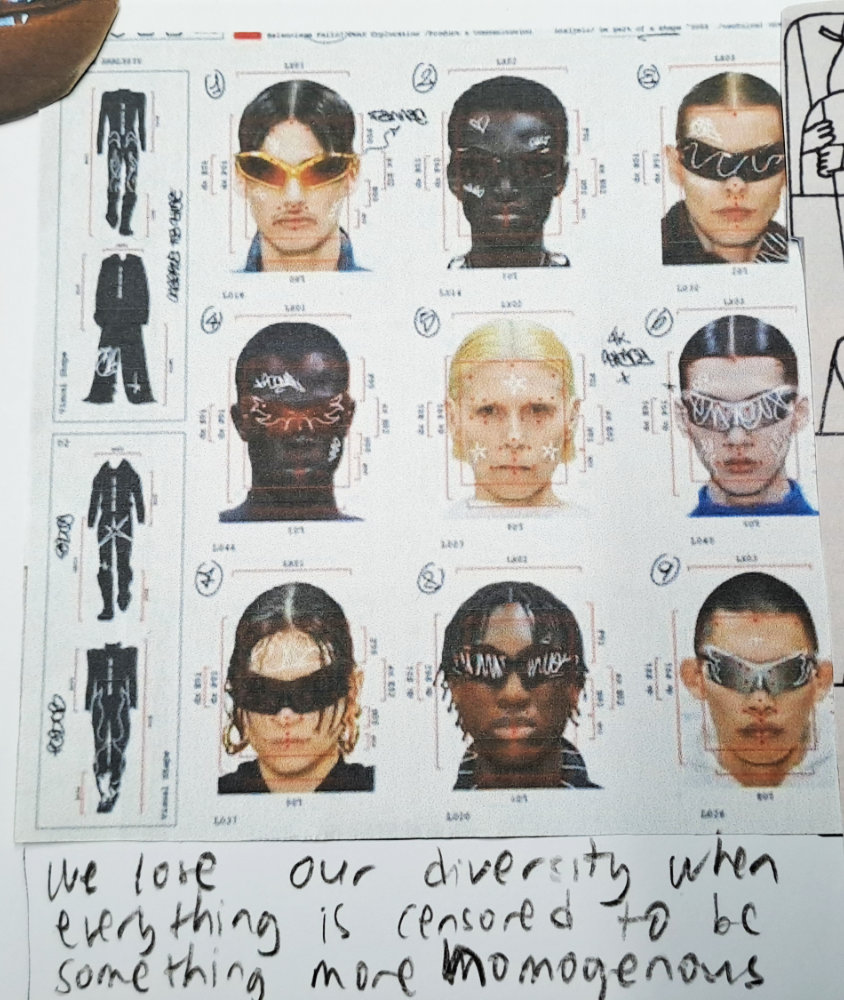
I chose this image and wrote the caption. For those who can’t read my bad handwriting, I wrote “We lose our diversity when everything is censored to be something more homegenous.”
From there, all the group members started coming up with ideas to put on the blank piece of paper. Every time we put pieces of cut paper together, we described what we liked about the picture, and how we think that it explains art censorship. We also had conversations about colonisation, female heroes, and indigenous stories, which I believe further enhanced the narrative of our collage.
Discussion and pushing boundaries of the blank page
After we got into the flow of collage-making, there were a few instances when we overlapped on each other’s pieces. One of my group members had an idea and wanted to paste her piece on someone else’s picture. There were some negotiations, and we agreed it was acceptable because it fits the narrative of art and censorship.
After that part, we started to push the boundaries further. One of my group members decided to stick only half of the picture on purpose, alluding to someone trying to set itself free. Then we started pasting our cut pieces outside the paper.
Towards the end of our collage-making, I noticed a strong narrative in the middle of the page and pointed it out to the group. It was so interesting to start with nothing and build a narrative almost instinctively, even though we were six different individuals with diverse backgrounds.
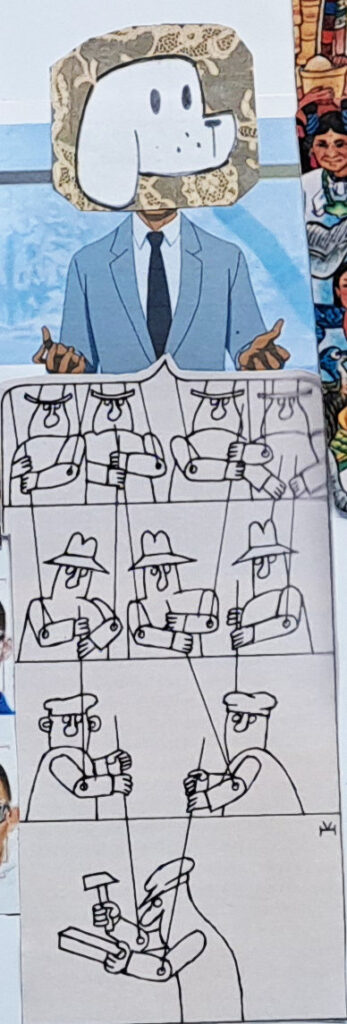
Centrepiece of the collage that highlights the main narrative of our collage. Notice that there are three overlapping visuals on top of each other, which we negotiated along the way.
I compared my group’s work with another group’s, and I realised the other group had worked in silos. When they presented their work, they had prefaced it that they did their own thing while working on the same collage. It is evident from the gaps between the pieces of stuck paper that they have kept to their own space while working together.
As I was comparing two pieces of artwork from different groups, I could not help but notice the contrast between them. One group appears to be following a cross-cultural communication approach that recognises differences across communities. However, this understanding of differences usually leads to individual change rather than collective transformation. Meanwhile, the other group appeared to practise intercultural communications, which focuses on the reciprocal exchange of cultural values, fostering growth as different communities learn from one another.1https://springinstitute.org/whats-difference-multicultural-intercultural-cross-cultural-communication/
At this point, it remains unclear whether cross-cultural and intercultural communication affects art-making within communities. I am just sharing my thoughts and feelings after observing two collages with different styles.
Collage-making as a form of community support
I felt therapeutic after the collage session, especially when I learnt new perspectives from other participants in a safe space. It helps that participants of the conference were there for the same reason: we believe in the freedom to be expression and, to some degree, not to be erased from our identities.
One thing that I appreciate about Lala’s facilitation of the workshop is the medium that we used to express ourselves. Collage is one of the lowest barriers to entry in the visual arts, and one does not need drawing skills to participate. Using collages means participants just cut out images that resonate with them. It helped that my group members were able to hold space as we discussed topics such as postcolonialism, female heroes, and indigenous voices. These are not easy topics, but we were able to share and work at the same thing.
On a more personal note, I had anxiety just days before the conference. Due to personal circumstances, I did not put myself out there as a writer and designer for a few years. Recent years have been better, but I still fear networking with others. Doing a collective collage with others that day was less threatening to me, and I was thankful to be able have a less pressured conversations. Hence, with proper facilitation and materials, art-making can be safe for people to overcome their fears.
Conclusion
I wish there were an actual demonstration of putting the same prompt into the LLMs to compare human information gathering with the LLMs’ trained data. Due to time constraints, we only executed the collage and did not have enough time to delve into the LLMs part. We briefly addressed her question about how LLMs affect art and censorship, which felt theoretical. I mentioned theoretical because not everyone is well-versed in LLMs, especially non-tech people, and it needs to be demonstrated.
Days after the conference ended, I found her zine about the collage workshop she did during the International Civil Society Week 2025. I gained a better understanding of what she wanted to achieve, especially in community-based research. Her research gave me new ideas to approach art in the community in a more relatable way.
If there was one thing AI could not replicate, it was the conversations I had with the group. LLMs may generate an impressive collage, but they cannot replicate grassroots dynamics in a community nor facilitate a safe space for people to create and express themselves.
References
-
- Schriefer, Paula. “What’s the Difference between Multicultural, Intercultural, and Cross-Cultural Communication?” April 18, 2016. https://springinstitute.org/whats-difference-multicultural-intercultural-cross-cultural-communication/.
- Nurlaela, Dewi. “Experimental Collage Workshop: Human Algorithm. Pilot Project Report by Dewi Nurlaela.” https://drive.google.com/file/d/1AcBGh6O04-TGpyWIe4tMfSUrZwKhT08h/view.
Featured image by federico izzo on Unsplash
References
- 1https://springinstitute.org/whats-difference-multicultural-intercultural-cross-cultural-communication/ ↩︎
