



After visiting the exhibition, I attended Dr Roopesh Sitharan’s talk titled Menggodam Kecerdasan yang dibuat, which translates to “Hacking the intelligence in the Artificial.”
Before I continue, I am not very well-versed in AI, so I had to refer to the IT specialist’s notes during the session. Moreover, I took a few months to process this talk. Despite my lack of understanding, I want to put this in writing so I can reference it and push my learning forward.
Back to the talk. Dr Roopesh pointed out the difference between Menggodam kecerdasan yang dibuat (Hacking the Intelligence in the Artificial) and Menggodam Kecerdasan Buatan (Hacking the Artificial Intelligence). Based on my understanding, the former is about how one approaches AI through their own artistic practices, while the latter is hacking the system.
He presented two arguments to support his point about Menggodam Kecerdasan yang dibuat, which are:
- How can we imagine differently in art?
- How can we ask a different set of questions about AI through cultural practice?
How can we imagine differently in art?
In the first argument, he talked about the artwork The Cascade by Robert Smith. This artwork was created in the year 1818. This painting was a colonial drawing of Penang and was a form of documentation by the colonisers. He highlighted that the vanishing point is found in the painting. Vanishing point is a Western art technique that creates the illusion of depth in painting.
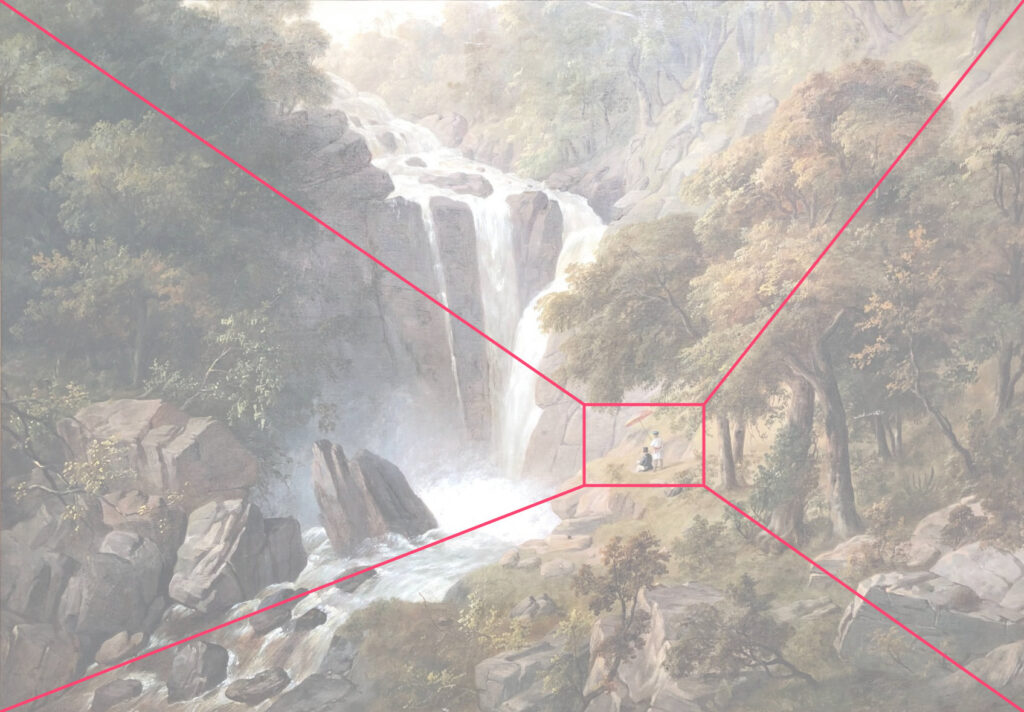
Figure 1: Since my notes did not clearly highlight the vanishing point on Dr Roopesh’s slides, I have highlighted how the vanishing point works in The Cascade by using a red rectangle and diagonal lines. Captain Robert Smith. The Cascade. 1818. Oil Painting. 69 x 100 cm. Penang State Museum & Art Gallery .
The colonial paintings from the 1800s are often picturesque, romanticising Malaya’s landscapes. This picturesque style in these colonial paintings appeared to be influenced by the European Neoclassical.1Excerpt of “The Treatment of the Local Landscape in Modern Malaysian Art” In the painting (Figure 1), the diagonal lines guide viewers’ eyes from the foreground of rocks and trees to the vanishing point, where two people appear in awe of the cascading waterfall. The European style of painting, together with the vanishing point, highlights what the colonisers are exposed to before incorporating it into their artworks.
He showed examples of vanishing point in other Western paintings and argued that copying visuals is nothing new. As part of the British administration, Robert Smith would have been exposed to the vanishing point in Western paintings and would have copied the technique, while AI copies visual techniques trained on existing data.
I like that Dr Roopesh reiterates the points of copying. I noticed that some people approach technology purely as a technical matter, without human intention. True, it may not follow the rhythm of nature (unless it is programmed to do so), but in every technological advancement, there is a human intention behind it. Is it to connect the world? Is it to improve productivity?
In my opinion, technology is a tool, and human intention guides it. For example, before AI, artists and designers used Adobe Photoshop to recreate images, and even then, we did not trust everything on the internet. Now, AI can quickly recreate images, leading people to believe it can do so without designers. Hence, when we approach artworks through the lens of technology in visual culture, we have to examine human intentions, as well as the time and context in which humans and/or AI are trained.
How can we ask a different set of questions about AI through cultural practice?
In the second argument, Dr Roopesh used The Great Malaysian Landscape by Redza Piyadasa (Figure 2). This artwork was created in 1972, just a year after the two policies that shaped Malaysia: the New Economic Policy and the New Cultural Policy. Malaysia was a very new nation, seeking a new multicultural identity while slowly moving away from colonial influences.
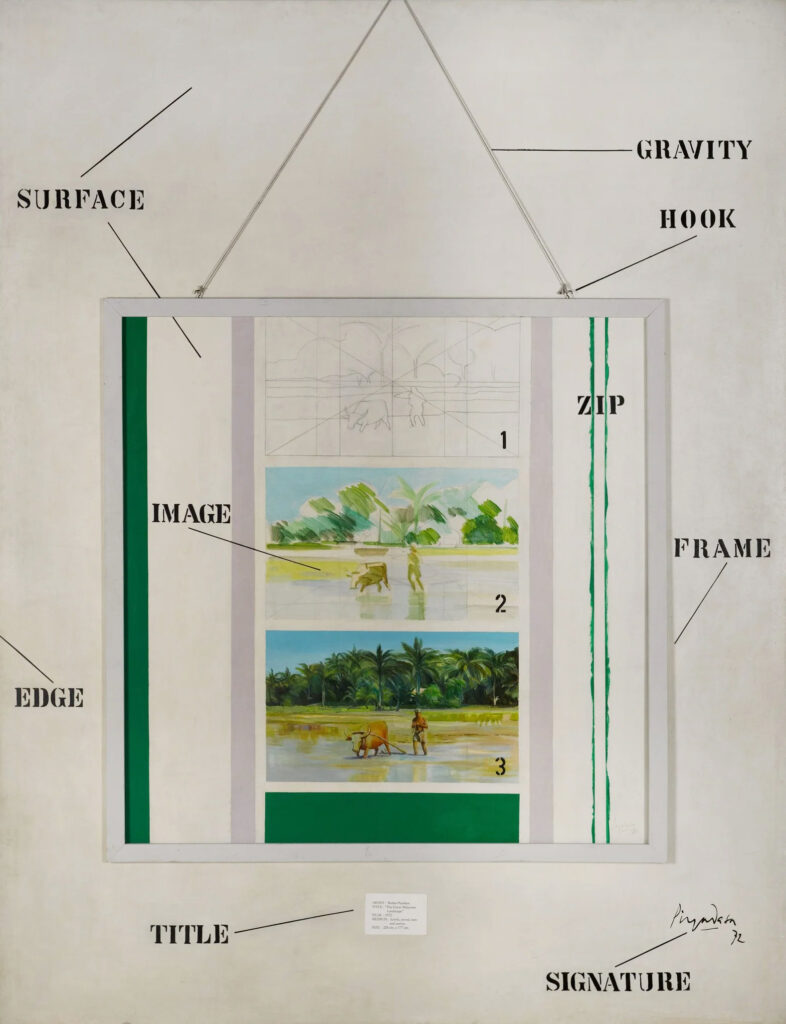
Figure 2: Redza Piyadasa. The Great Malaysian Landscape. 1972. Acrylic and mixed media. 152.5 x 106 cm. National Art Gallery Malaysia.
In The Great Malaysian Landscape, Redza Piyadasa departs from the colonial picturesque paintings. In this mixed-media work, a large canvas is used. On the large canvas, another framed painting is hung with a string. In the framed canvas in the middle, there are 3 full frames depicting what appears to be a process of creating a landscape of a paddy farmer ploughing a paddy field with his bull. The top frame is a pencil sketch of the landscape. It is followed by the second frame, in which colour blocking shapes the different areas of the landscape. Finally, the last frame is the painting of the landscape in between. Every element of the painting is labelled, including frame, zip, edge, image, surface, gravity, hook, and signature. These elements appeared to be describing elements that make a painting.
Viewing this artwork feels very meta, as it shows a landscape within the landscape. The artist appeared to be very aware of how Western influence shapes viewers’ perceptions towards visuals. Hence, this artwork highlighted the different elements that make up an artwork, offering viewers clues to deconstruct how much we have been influenced by Western constructs of art, especially the vanishing points in colonial paintings.
Finally, he ended the talk about relational AI, in which AI makes sense to humans and works for us, rather than fully controlling us.
At times, I was very confused, especially when he compared The Great Malaysian Landscape with machine learning. Part of my confusion stemmed from not having learned much about how AI works, and it was hard to understand until I talked it over with the IT specialist who was at the talk with me.
Final Thoughts
Despite my lack of knowledge of this topic, I am glad to listen to this talk from a different perspective. As an art practitioner, I heard discussions about the ethics of AI authorship, especially with creatives. The topic of authorship is ongoing, and I wanted to listen to more than just authorship. I know AI is not going away, and I wanted to know how to move forward with discourse in art as culture evolves with AI.
I also understand Redza Piyadasa’s works better. Redza Piyadasa’s works are often mentioned in the Malaysian art syllabus, especially those from the 1970s. Also, there have been many stories (within the Visual Art Department) about Redza Piyadasa’s disagreements in art circles in the past. When I started my research, I was not well-versed in postcolonialism, so I avoided his works. Now that I have a better understanding of postcolonialism, I will revisit his works.
When Dr Roopesh used The Cascade and The Great Malaysian Landscape to discuss colonialism and AI, I saw a link between them. The problem with how we think about colonialism is that we always focus on British colonial times. Colonialism means taking and keeping control over others in politics, the economy, society, and culture.2I prefer the Wikipedia description of colonialism, as it is phrased based on four different references. If we are not careful, we might end up controlling others, and now technology can do so, since it is trained only on the data we give it. Depending on people’s motives, they can train AI with certain data to change stories and end up controlling others.
I am not sure if I will listen to another talk by Dr Roopesh, but I will read up on these topics before attending AI-related talks, so I will not be so lost and will be able to process them better in my own thoughts.
References
Ray Langenbach. “Excerpt of “The treatment of the local landscape in Modern Malaysian Art””. Malaysian Design Archive. https://search.malaysiadesignarchive.org/item/excerpt-of-the-treatment-of-the-local-landscape-in-modern-malaysian-art/#pid=1.
Wikipedia. “Colonialism”. https://en.wikipedia.org/wiki/Colonialism.
